The average cost of a network breach in 2026 is $4.9 million. Most trace back to the same root causes: flat networks, missing MFA, unpatched perimeter devices. This guide covers the controls that actually move the needle — prioritized practices used by mature security teams, not a generic wishlist.
1. Adopt Zero Trust — Starting With Identity
Zero Trust assumes breach and verifies every connection explicitly, regardless of network segment. Start with identity: enforce MFA on every account, deploy conditional access policies, and replace standing VPN with per-session ZTNA. Every lateral move an attacker makes should require re-authentication.
- Enable MFA across all accounts — privileged and standard
- Deploy an identity-aware proxy: Cloudflare Access, Zscaler, or Palo Alto Prisma
- Map critical assets and enforce least-privilege access policies
Reality check: Adding MFA does not make your architecture Zero Trust. Real ZTA requires device posture checks, micro-segmentation, and continuous session validation. Start small but be honest about your maturity.
2. Segment Your Network Aggressively
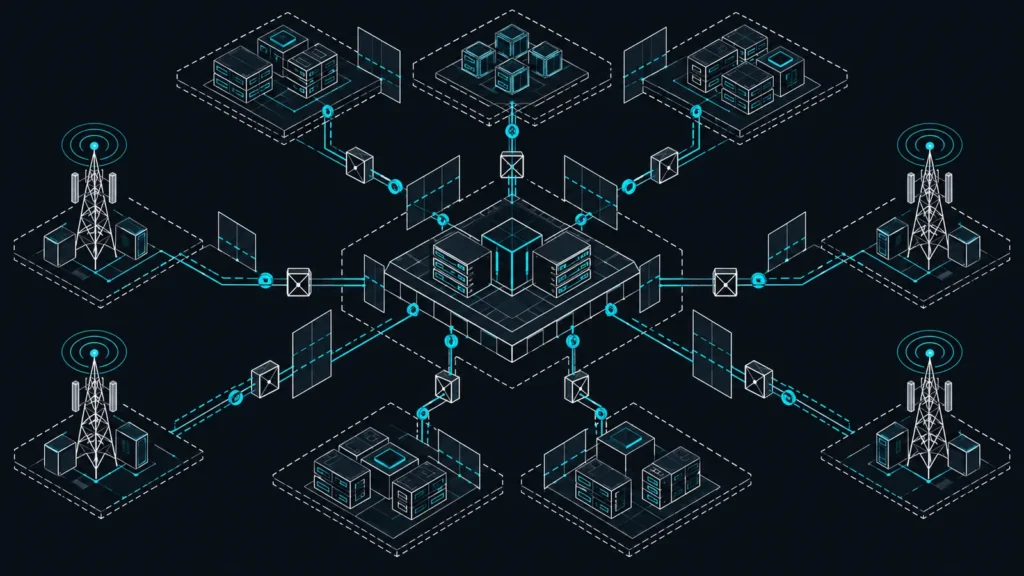
A flat network means one compromised endpoint can reach domain controllers, file servers, and backup systems. Segmentation limits the blast radius. Separate workstations from servers, IoT from corporate, and guest Wi-Fi from everything. Use VLANs at minimum; add micro-segmentation with VMware NSX or Illumio if budget allows.
- VLAN 10: Workstations
- VLAN 20: Servers and domain controllers
- VLAN 30: IoT and OT devices
- VLAN 40: Guest and contractor Wi-Fi
- VLAN 50: Security tooling — SIEM, EDR, backups
3. Patch Critical CVEs Within 72 Hours
The 2024 Verizon DBIR found the median time between CVE publication and exploitation dropped to 5 days in 2026. A 30-day patch cycle is not acceptable for internet-facing systems. Critical CVEs (CVSS 9.0+) on VPNs, firewalls, and web-facing applications need 72-hour remediation targets.
High-risk targets in 2026: VPN concentrators, firewalls, and network management interfaces are the most actively exploited device categories. Patch these before anything else, every time.
4. Deploy and Tune IDS/IPS Rules
Out-of-box IDS with default rules floods analysts with false positives. That noise trains your team to ignore alerts. Spend the first 30 days tuning: suppress known-good traffic, write custom rules for your environment, and pipe alerts into your SIEM. Suricata and Snort are both capable — configuration separates useful deployments from shelfware.
5. Block Malicious Domains at the DNS Layer
DNS is the phone book for malware. C2 frameworks, phishing kits, and data exfiltration channels all rely on DNS queries. Deploy DNS filtering — Cloudflare Gateway and Cisco Umbrella both offer enterprise-grade blocking — and log every query to your SIEM. A finance workstation querying an unusual domain at 3 AM is worth investigating immediately.
6. Monitor East-West Traffic, Not Just the Perimeter
Perimeter firewalls only catch traffic entering and leaving your network. Lateral movement between internal systems — where most breach damage happens — goes unseen. Deploy Network Traffic Analysis tools like Darktrace, ExtraHop, or Vectra AI to baseline internal behavior and flag anomalies: a workstation scanning the subnet, a server querying a new external domain, large internal file transfers outside business hours.
Quick win: Enable NetFlow on your core switches today. Even without a dedicated NTA tool, NetFlow data in your SIEM gives east-west visibility at near-zero cost.
7. Enforce 802.1X Authentication
802.1X authenticates devices before they receive network access — no more plug-in-and-you-are-connected. Pair it with certificate-based authentication for corporate devices and WPA3-Enterprise for wireless. Deprecate WPA2-Personal on all business SSIDs and quarantine non-compliant devices automatically.
8. Encrypt All Internal Traffic
Assume your network is already compromised. Unencrypted protocols hand attackers credentials, session tokens, and sensitive data from a single packet capture. Enforce TLS 1.3 for all application traffic, disable SMBv1, switch to LDAPS, and audit for cleartext protocols using Wireshark or your NTA tool. There is no acceptable reason for plaintext authentication protocols in 2026.
9. Control Privileged Access With PAM
Privileged accounts are the crown jewels attackers target first. Implement a Privileged Access Management solution — CyberArk, BeyondTrust, or open-source Teleport — to rotate credentials automatically, record privileged sessions, and enforce just-in-time access. No admin account should have a persistent, standing password that never rotates.
10. Test Your Controls Quarterly
Controls that are not tested are not controls. Run quarterly penetration tests on your network perimeter. Run tabletop exercises for your incident response team. Use breach and attack simulation tools like SafeBreach or Cymulate to continuously validate that your EDR rules and firewall policies catch what they should. The goal is finding gaps before attackers do — not a clean report.
Takeaway: Network security is configuration, process, and habit — not a product purchase. Start with segmentation and MFA, measure your patch cycle weekly, and build from there. See our Security Tools page for vetted vendor recommendations in each category.
Network Security Tools Comparison
Choosing the right tools for each network security function is critical. Here is how the leading options compare:
| Function | Tool | Best For | Cost |
|---|---|---|---|
| IDS/IPS | Suricata | Multi-threaded, high performance | Free / Open Source |
| IDS/IPS | Snort | Largest rule community | Free / Open Source |
| Network Traffic Analysis | Darktrace | AI-based anomaly detection | Enterprise pricing |
| Network Traffic Analysis | ExtraHop | Deep packet inspection, cloud-native | Enterprise pricing |
| DNS Filtering | Cloudflare Gateway | Free tier, fast DNS resolution | Free / $7/user/mo |
| DNS Filtering | Cisco Umbrella | Enterprise, Talos threat intel | ~$2.20/user/mo |
| NAC | Cisco ISE | Enterprise, deep Cisco integration | Enterprise pricing |
| NAC | Forescout | Agentless, IoT visibility | Enterprise pricing |
🔗 Authoritative Sources
Frequently Asked Questions
What is the most important network security control in 2026?
Network segmentation combined with Zero Trust Network Access (ZTNA) provides the highest security ROI. Segmentation limits lateral movement after a breach, while ZTNA ensures every connection is authenticated regardless of network location. MFA on all accounts is the single most impactful identity control.
How often should network security controls be tested?
Critical network controls should be tested quarterly through penetration testing and continuously through breach and attack simulation (BAS) tools. Firewall rules should be reviewed monthly. IDS/IPS rules should be tuned continuously as new threat patterns emerge.
What is network micro-segmentation?
Micro-segmentation is a security technique that divides a network into small, isolated zones with granular access controls at the workload level. Unlike traditional VLANs that segment by subnet, micro-segmentation applies security policies per application or even per container, preventing lateral movement between workloads even within the same subnet.
What tools are used for network security monitoring?
Network Traffic Analysis (NTA) tools like Darktrace, ExtraHop, and Vectra AI monitor east-west traffic for anomalies. SIEM platforms aggregate logs from firewalls, IDS/IPS, and endpoints. NetFlow analysis provides traffic baseline data. EDR solutions monitor endpoint-level network connections.