
Building security operations center SOC is one of the most critical topics in enterprise cybersecurity today. Most organizations build a SOC the wrong way: they buy a SIEM, hire two analysts, and call it a security operations center. Three months later, the analysts are drowning in alerts, MTTR is measured in weeks, and the SIEM license is the most expensive piece of infrastructure that provides the least operational value. This guide covers what a functional SOC actually requires — in terms of people, processes, and technology — and how to build it without starting over twice.
Choosing Your SOC Model First
The model decision comes before any tool purchase. Three options:
- Internal SOC: Full control, deep institutional knowledge, high cost. Requires at minimum 6-8 analysts for 24/7 coverage (shift coverage math: 3 shifts x 2 analysts, plus management and Tier 3). Budget $1.5-2.5M annually for a small but genuine 24/7 internal SOC.
- Managed SOC (MSSP): Lower cost, faster time to coverage, lower institutional knowledge. Works well for organizations without existing security operations capability. Budget $15,000-80,000/month depending on scope and SLAs.
- Hybrid: Internal team handles business hours and Tier 2-3 analysis; MSSP covers overnight and weekends. Best of both for mid-market organizations. Most practical option for teams of 2-5 existing security staff.
Staffing math: 24/7/365 coverage requires a minimum of 4.2 FTEs per shift seat after accounting for vacation, sick leave, and training. A 3-analyst team cannot provide continuous coverage regardless of on-call policies.
Selecting a SIEM: What Actually Matters
The SIEM market is crowded and the marketing is nearly identical across vendors. Evaluate on four criteria that vendors rarely highlight in demos:
- Ingestion cost model: Data-volume pricing (GB/day) punishes you for collecting everything. Endpoint-count or entity-based pricing is more predictable. Understand your cost at 2x and 5x current data volume.
- Detection-as-code support: Can your team write and version-control detection rules in a standard format (SIGMA, KQL, SPL)? Vendor-locked detection languages make SIEM migrations painful.
- Community detection content: Does the vendor have an active rule repository? Microsoft Sentinel and Splunk have the largest communities; Elastic and Chronicle have strong open-source ecosystems.
- SOAR integration depth: Evaluate not the number of integrations but the quality. A 200-connector integration list means nothing if the EDR connector does not support bidirectional actions.
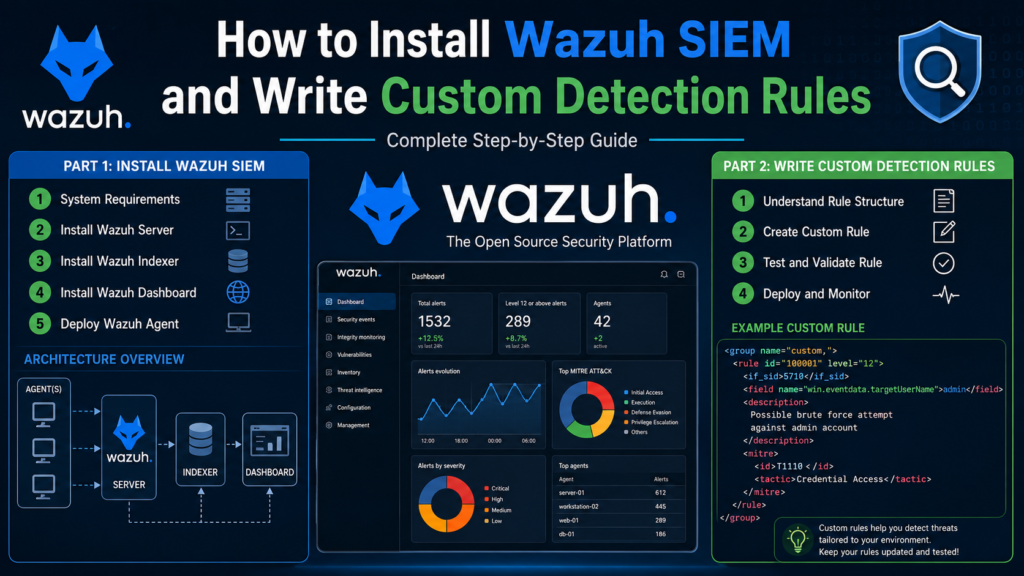
In 2026, the leading platforms for most organizations are: Microsoft Sentinel (best for Microsoft-heavy environments, consumption pricing), Splunk Enterprise Security (most mature, highest cost), Chronicle Security Operations (Google-backed, strong for large log volumes), and open-source Wazuh (free, capable, high operational overhead).
The Alert Triage Model That Works
Tier-based triage only works if each tier has clear escalation criteria and defined SLAs. Without them, everything escalates to Tier 2 and your senior analysts spend their time on false positives.
- Tier 1 (Alert Analyst): Initial triage within 15 minutes of alert. Validate the alert, enrich with threat intelligence, dismiss obvious false positives, escalate genuine detections. SLA: 15-minute initial response, 30-minute disposition on all P1 alerts.
- Tier 2 (Incident Analyst): Deep-dive investigation on escalated alerts. Scope the incident, identify affected assets, recommend containment. SLA: begin investigation within 1 hour of escalation.
- Tier 3 (Threat Hunter / Senior Analyst): Proactive threat hunting, complex incident investigation, SIEM tuning, detection rule development. No reactive alert queue — proactive only.
Alert fatigue reality: Gartner research found that SOC analysts dismiss up to 45% of alerts without investigation because of alert volume. If your Tier 1 analysts are closing alerts without reading them, your detection program is producing noise, not signal. Fix tuning before hiring more analysts.
SOAR: What to Automate First
SOAR automation works best on high-volume, low-complexity tasks that follow predictable decision trees. Start with these three playbooks before building anything more complex:
- Phishing triage: Receive reported email, extract URLs and attachments, submit to VirusTotal and sandbox, enrich with threat intel, auto-close if clean, escalate if malicious. Saves 20-30 minutes per reported phishing email.
- IOC enrichment: On any alert containing an IP, domain, or file hash, automatically query threat intelligence sources and append the enrichment to the alert. Analysts get context in seconds instead of spending 5 minutes on manual lookups.
- User account lockout response: On detection of credential stuffing or brute force, automatically disable the targeted account, notify the user, and open an HR ticket. Time-sensitive action that should not wait for human review.
SOC metrics to track from day one: MTTD (Mean Time to Detect), MTTR (Mean Time to Respond), false positive rate per detection rule, analyst alert handling time, and escalation rate. Review these weekly. If MTTD is increasing, your environment is growing faster than your detection coverage. See our Security Tools page for SIEM and SOAR platform comparisons.
🔗 Authoritative Sources
Frequently Asked Questions
What is a Security Operations Center (SOC)?
A Security Operations Center (SOC) is a centralized team of security analysts who monitor, detect, investigate, and respond to cybersecurity threats 24/7. The SOC combines people, processes, and technology — primarily a SIEM platform, EDR solutions, and threat intelligence feeds — to provide continuous visibility into an organization's security posture. SOC models range from fully internal to fully managed (MSSP) to hybrid arrangements.
What is MTTR and MTTD in a SOC?
MTTD (Mean Time to Detect) measures how long it takes the SOC to identify a security threat after it begins. MTTR (Mean Time to Respond) measures how long from detection to successful containment or resolution. Industry benchmarks in 2026: MTTD under 1 hour for critical incidents, MTTR under 4 hours. Organizations with mature SOAR automation typically achieve MTTD under 15 minutes and MTTR under 1 hour for high-severity alerts.
What is the difference between a SOC and a CERT/CSIRT?
A SOC (Security Operations Center) focuses on continuous monitoring, detection, and initial response to security events. It operates reactively in real-time. A CERT (Computer Emergency Response Team) or CSIRT (Computer Security Incident Response Team) focuses specifically on incident handling, forensic investigation, and coordinating response to confirmed security incidents. Many organizations have both: the SOC handles day-to-day monitoring, and the CSIRT activates for major incidents.
What is SOAR in cybersecurity?
SOAR (Security Orchestration, Automation and Response) platforms automate repetitive SOC tasks through playbooks — predefined workflows triggered by specific alert conditions. Common SOAR automations include: phishing email triage (extract IOCs, check threat intel, auto-close or escalate), user account lockout response, and IOC enrichment. Leading SOAR platforms include Palo Alto XSOAR, Splunk SOAR, and Microsoft Sentinel playbooks. SOAR reduces analyst workload by 40-60% for automated playbook types.