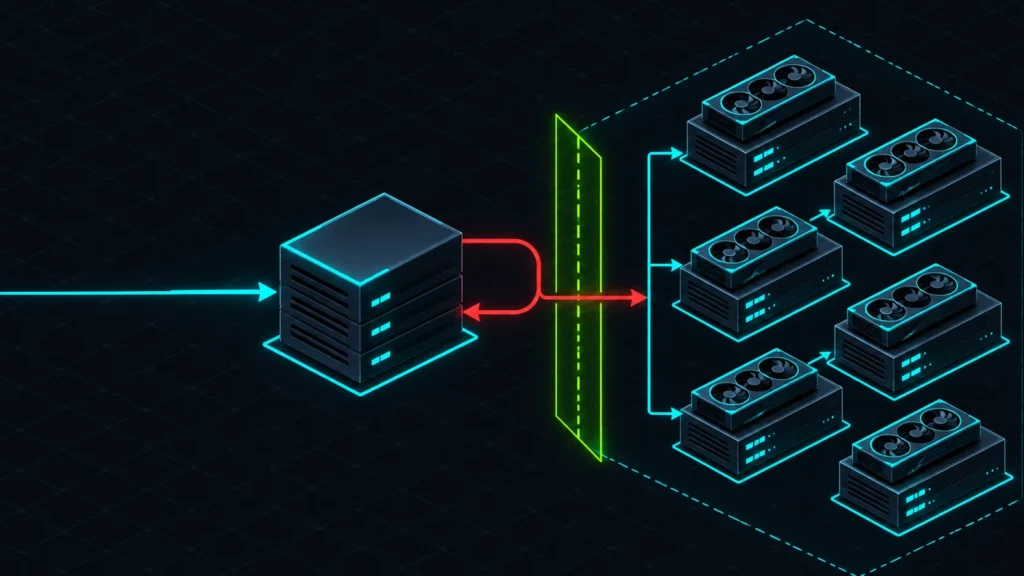

Ruflo’s default Docker Compose deployment once exposed more than a management endpoint. In affected releases, the MCP bridge listened on all interfaces without authentication, while a server-side tool path could reach terminal_execute. That combination made remote command execution possible for an unauthenticated network client when port 3001 was reachable.
The vendor disclosed GHSA-c4hm-4h84-2cf3 and released Ruflo 3.16.3 on 1 July 2026. GitHub added the issue to its reviewed advisory database as CVE-2026-59726 on 24 November. This is therefore not a new patch released today. It is a timely reason to verify older deployments, especially experiments that were started from the default Compose file and then left running on a cloud VM.
What CVE-2026-59726 exposed
The vulnerable bridge accepted MCP requests at POST /mcp and grouped routes without an inbound authentication gate. Ruflo’s Compose configuration published the bridge on host port 3001 and MongoDB on 27017 across all interfaces. Inside the bridge, general tool calls were routed through executeTool to MCP backends. The development tool group was enabled by default and included terminal_execute.
A blocklist existed, but the vendor’s analysis found that it was applied in the autopilot flow rather than at the shared tool-dispatch boundary. Direct MCP requests could therefore bypass it. Because the backends inherited the parent process environment, successful command execution could expose provider credentials configured for services such as OpenAI, Google, OpenRouter, or Anthropic.
The risk did not stop at a container shell. The vendor also identified an unauthenticated MongoDB service and a path to modify the AgentDB learning store. A compromised pattern store could influence later agent output even after the vulnerable container was replaced. This is why a patch-only response is incomplete for an instance that was exposed to an untrusted network.
Who should treat this as an incident
Ruflo versions earlier than 3.16.3 are listed as affected. Version presence alone does not prove compromise. The higher-risk case is an affected default deployment whose bridge or MongoDB port was reachable from the internet or another untrusted network.
Escalate from routine patching to incident response if any of the following are true:
- TCP port 3001 or 27017 was publicly reachable, forwarded through a firewall, or exposed by a permissive cloud security group.
- A reverse proxy, ingress rule, or tunneling service made the MCP routes available without an authentication layer.
- Provider API keys with material privileges or billing access were present in the bridge environment.
- Logs show unexpected calls to
/mcp, unfamiliar tool invocations, or unexplained provider usage. - The AgentDB pattern store or MongoDB contains entries that cannot be tied to an authorized workflow.
An instance that was bound only to loopback is less exposed, but local users, adjacent containers, SSRF paths, or a compromised host can still cross that boundary. Confirm the actual network path rather than assuming a Compose file tells the whole story.
What Ruflo 3.16.3 changed
The security release moved several controls to safer defaults. The MCP bridge now binds to 127.0.0.1 unless an operator explicitly selects a non-loopback address. A public bind requires MCP_AUTH_TOKEN, and the process refuses to start without it. Token checks use constant-time comparison.
The release also moved the terminal_execute restriction into the common server-side dispatch path. Terminal execution is disabled unless MCP_ENABLE_TERMINAL=true is deliberately set. The updated Compose deployment enables MongoDB authentication, requires MONGO_INITDB_ROOT_PASSWORD, uses a read-only bridge root filesystem with temporary writable storage, and wires an explicit CORS allowlist.
These are meaningful controls because they address the chain at several points: exposure, authentication, dangerous-tool authorization, credential-bearing process boundaries, and data-store access. They should not be used as a reason to publish the bridge broadly. Keep it private unless a documented business requirement and compensating controls justify remote access.
Response plan for Ruflo operators
1. Contain reachable services
Block untrusted access to ports 3001 and 27017 at the host firewall, cloud security group, load balancer, and any upstream NAT or tunnel. Do not rely only on a container port mapping. If the instance appears compromised, preserve relevant logs and snapshots under your incident-response procedure before rebuilding it.
2. Upgrade and redeploy safely
Upgrade to Ruflo 3.16.3 or a later supported release. Recreate the deployment from a reviewed configuration rather than merely restarting an old container. Confirm that the bridge and MongoDB bind to loopback or a private interface, that MongoDB authentication is enabled, and that terminal execution remains disabled unless it is essential.
For a deliberately remote MCP service, use a strong, unique bearer token, restrict the source networks, terminate TLS at a controlled proxy, and keep the service out of direct internet reach. A bearer token sent over cleartext HTTP can be captured and replayed.
3. Rotate credentials according to exposure
If an affected bridge was reachable from an untrusted network, rotate every provider key that was present in its environment. Revoke the old value rather than only adding a new one. Review provider audit and billing records for unfamiliar models, projects, regions, request spikes, or new resources. Extend the review to any database, webhook, repository, or cloud credential injected into the same process.
If the service was not exposed, use evidence to decide whether rotation is required. Avoid turning a version finding into an unsupported claim that secrets were stolen.
4. Hunt for persistence and tampering
Review reverse-proxy, firewall, flow, container, and application logs for connections to port 3001 or requests to /mcp and /mcp/<group> from unexpected sources. Look for tool calls involving terminal execution, new child processes, downloads, outbound callbacks, and changes to startup files or mounted volumes.
Inspect AgentDB for unfamiliar agentdb_pattern-store entries, especially patterns created during an exposure window or containing unexpected instructions. Review MongoDB users, collections, recent writes, and configuration changes. The advisory does not publish a universal malicious hash, domain, or command, so detection must be based on your own baseline and logs.
This layered approach mirrors the management-plane lesson in our Portainer SSRF and egress review: a control plane’s network reach and stored credentials shape the real blast radius. For another AI infrastructure example, see our GPUStack admin-bypass response guide.
Safe lab: audit a local Compose deployment
Prerequisites: an isolated test VM or an authorized Ruflo host, Docker Engine with the Compose plugin, a local copy of the deployment directory, and permission to inspect listeners. These commands are read-only. They do not send MCP requests, execute tools, or test exploitation. They have not been run against your environment.
docker compose version
docker compose ps
docker compose images

# Render the effective configuration and inspect security-relevant settings.
# Do not paste the full output into a public ticket; it may contain secrets.
docker compose config | grep -nE '3001|27017|MCP_BIND_HOST|MCP_AUTH_TOKEN|MCP_ENABLE_TERMINAL|MONGO_INITDB_ROOT_PASSWORD|read_only'

# Check which addresses are actually listening on the host.
sudo ss -lntp | grep -E ':(3001|27017)\b'
Expected output: a patched default deployment should show loopback-bound host mappings such as 127.0.0.1:3001 and 127.0.0.1:27017, or no published database port at all. MongoDB should require a root password, the bridge should use a read-only root filesystem, and MCP_ENABLE_TERMINAL should be absent or false unless there is a reviewed need. A non-loopback MCP bind should have a configured authentication token and network restrictions.
Troubleshooting: if docker compose is unavailable, use the deployment’s actual orchestrator inventory instead of installing tools on a production host without approval. If ss prints nothing, the service may be stopped, bound inside a different network namespace, or published through Kubernetes, a proxy, or a cloud load balancer. Check the whole path. If Docker access is denied, request authorized read access; do not loosen socket permissions.
Cleanup: none is required because the commands do not change the deployment. Remove any locally saved configuration output if it contains credentials. Do not use the public exploit chain as a validation test.
Architecture lessons beyond one CVE
CVE-2026-59726 is a useful example of why an AI control plane needs conventional security controls at every boundary. MCP tool descriptions are not authorization. A user-interface blocklist is not a server-side policy. Containerization does not protect environment secrets from code running inside the container. Replacing a container does not remove malicious state from a persistent database.
For new agent platforms, put authentication before every network-accessible tool endpoint, centralize authorization at the final dispatch point, isolate credentials by backend, default listeners to loopback, and separate persistent learning data from untrusted tool output. Add tests that fail when a dangerous tool becomes reachable through a new route. These design choices are easier to enforce before an orchestration service becomes operational infrastructure.
Conclusion
Ruflo 3.16.3 closes the published unauthenticated MCP bridge chain, but exposed operators still have incident-response work to do. Confirm the running version and effective bind addresses, restrict the bridge and database, rotate credentials when exposure warrants it, and inspect AgentDB and MongoDB for unauthorized changes. The most important question is not simply whether an old package exists. It is whether an untrusted client could reach a credential-bearing tool server and leave persistent state behind.
Primary references
- Ruflo security advisory GHSA-c4hm-4h84-2cf3 / CVE-2026-59726, published 1 July 2026 and reviewed by GitHub on 24 November 2026.
- Ruflo 3.16.3 security release notes, released 1 July 2026.
- ADR-166: MCP bridge remediation design and operational response, dated 30 June 2026.
- Ruflo pull request 2521, implementing the Phase 1-3 remediation and regression checks.