
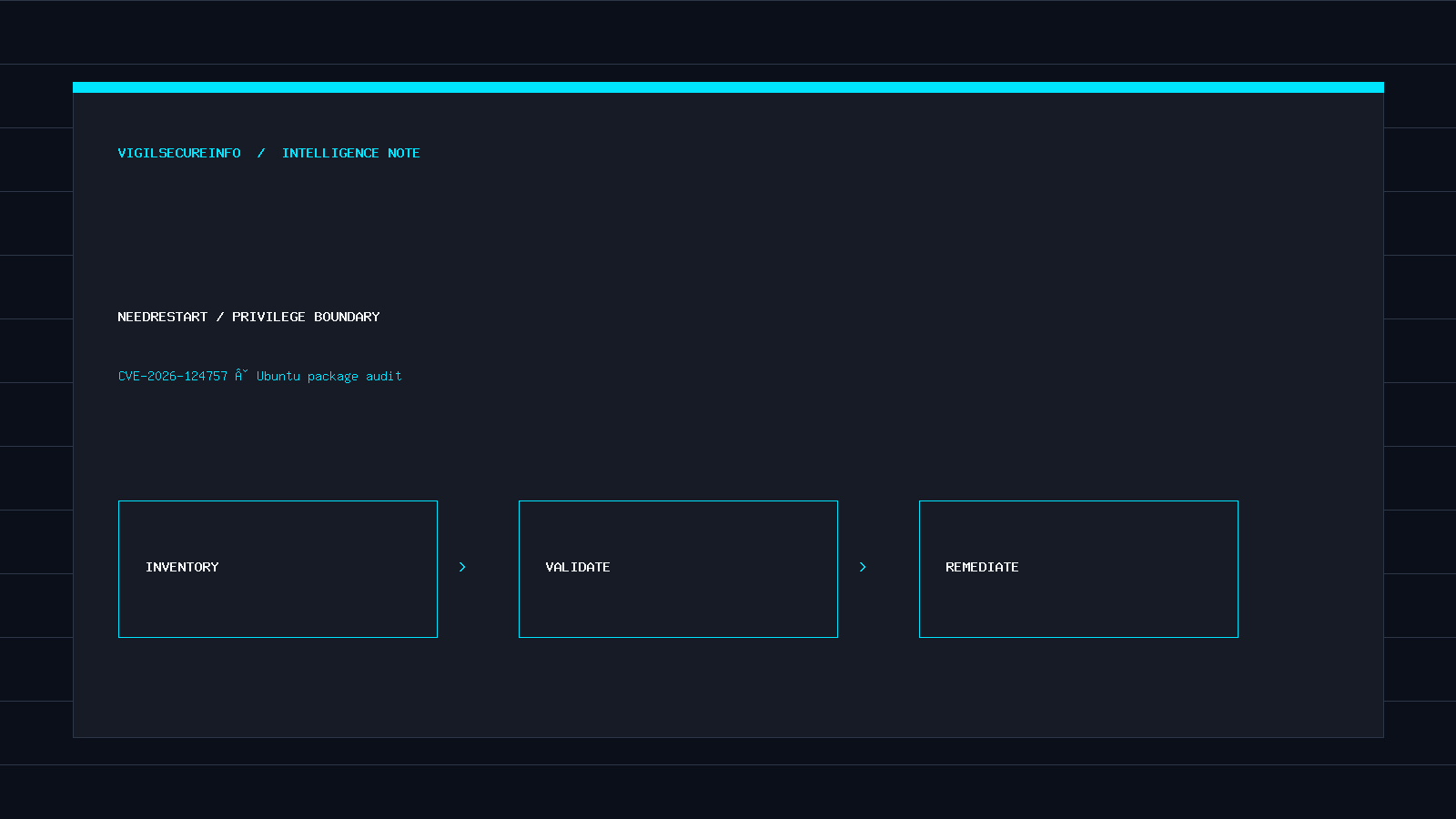
Ubuntu published USN-9151-1 on November 18, 2026 for CVE-2026-124757 in needrestart, the utility that identifies services needing a restart after library upgrades. The advisory says improper handling of systemd cgroup paths and process names could let a local attacker escalate privileges. This is a local-access issue, not a claim that an unauthenticated internet visitor can directly take over a host.
What the advisory establishes
Canonical’s security notice lists Ubuntu 26.10, 26.04 LTS, 24.04 LTS, 22.04 LTS, 20.04 LTS, 18.04 LTS, and 16.04 LTS. The notice recommends a standard system update and supplies release-specific fixed package builds. It does not assert exploitation in the wild, so response priority should reflect local-user exposure, multi-tenant workloads, and whether a vulnerable version is installed.
Fixed package baselines
- Ubuntu 26.10: needrestart 3.11-1ubuntu2.26.10.1.
- Ubuntu 26.04 LTS: 3.11-1ubuntu2.26.04.1.
- Ubuntu 24.04 LTS: 3.6-7ubuntu4.6.
- Ubuntu 22.04 LTS: 3.5-5ubuntu2.6.
- Ubuntu 20.04 LTS: 3.4-6ubuntu0.1+esm4 via Ubuntu Pro ESM Apps.
- Ubuntu 18.04 LTS: 3.1-1ubuntu0.1+esm4 via Ubuntu Pro ESM Apps.
- Ubuntu 16.04 LTS: 2.6-1ubuntu0.1~esm4.
Those strings are package builds, not a universal numeric threshold. Check the notice and your repository entitlement for older releases. A package with a different distribution suffix may still include a vendor backport, but it needs evidence from that vendor.
Why a restart helper matters
needrestart often appears in routine patching workflows with elevated privileges. A parser that trusts attacker-influenced process metadata can cross a boundary between unprivileged local state and privileged administration. Canonical’s public notice identifies the problematic input classes but does not publish a full exploit narrative; avoid assuming a specific payload, affected invocation mode, or detection signature from the short advisory alone.
Hands-on lab: verify the package safely
Prerequisites
Use a disposable Ubuntu VM or staging host, sudo rights, a current snapshot, and an approved package repository. This lab does not attempt privilege escalation and makes no claim that the steps were executed against a vulnerable host.
Inspect release and installed package
cat /etc/os-release | sed -n '1,6p'
dpkg-query -W -f='${Package} ${Version}\n' needrestart 2>/dev/null || echo 'needrestart not installed'
apt-cache policy needrestart
Expected output shows your Ubuntu release, the installed package build if present, and the candidate build from configured repositories. Match the installed build against the exact release row in USN-9151-1. An absent package is not proof that a different restart tool is safe; it only narrows this advisory’s scope.
Preview and apply the approved update
sudo apt update
apt-get -s install --only-upgrade needrestart
# After change approval and normal maintenance checks:
sudo apt install --only-upgrade needrestart
dpkg-query -W -f='${Package} ${Version}\n' needrestart
The simulation should show the candidate transaction without changing packages. The real installation changes the package only after your maintenance approval. If the candidate remains below Canonical’s fixed build, check repository configuration and Ubuntu Pro entitlement rather than force-installing an unrelated archive package.
Troubleshooting and cleanup
If apt-cache policy has no candidate, verify active repositories and release support. If a package is held, inspect apt-mark showhold before removing the hold. The inventory commands leave no artifacts; for a lab VM, revert the snapshot after testing. Do not roll back a production security patch merely to recreate an old state.
Operational response
Prioritize shared build agents, multi-user bastions, developer VMs with untrusted local workloads, and servers where unprivileged accounts exist. Patch through normal fleet tooling, confirm the installed build afterward, and review privileged command logs and process anomalies if you already have evidence of local compromise. A package update removes the known vulnerable code path but cannot prove a host was never misused. The site’s Java fleet audit guide illustrates the same inventory-first principle for another package ecosystem.
Conclusion
USN-9151-1 is an actionable host-patching notice: identify where needrestart is installed, compare against the release-specific fixed build, update from trusted repositories, and record verification. Keep the language of your incident ticket as precise as the advisory: possible local privilege escalation, not confirmed remote exploitation.