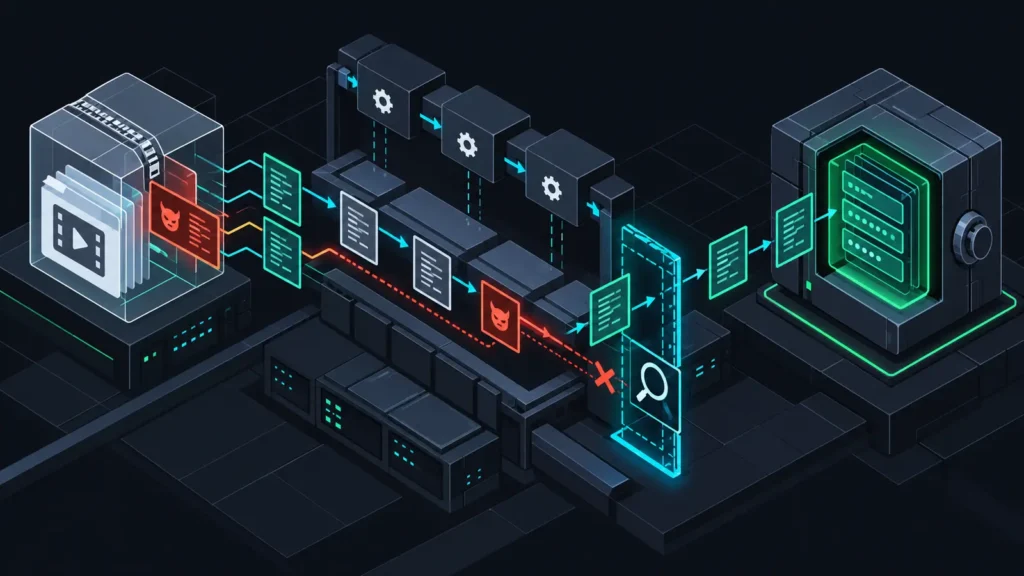
Git’s November 10, 2026 coordinated security releases address six vulnerabilities in the workflows that pull, transform, and merge repository content. GitHub updated its technical advisory on November 17 with additional guidance. The practical question for defenders is not merely “what version is on my laptop?” It is which Git binary a build runner, IDE, desktop client, hosting service, or import job actually executes.
What was fixed, and when
The Git project released 2.56.1 and backports 2.55.1, 2.54.1, 2.53.1, 2.52.1, 2.51.3, and 2.50.2 on November 10. Its release announcement names all six CVEs. GitHub’s November 17 updated explanation describes the affected operations and advises updating bundled copies as well as system packages. Distribution backports may carry the fix without showing those upstream version numbers, so verify the distributor’s security notice for your exact package.
The six paths to review
- CVE-2026-111760: an integer-truncation path discrepancy can redirect repository metadata during a malicious clone and may lead to code execution, particularly in recursive workflows.
- CVE-2026-113408: a server-advertised unborn HEAD symref in protocol v2 could contain traversal components, leading to an unintended write on a later reference update.
- CVE-2026-114467: stripping more than two signatures from a crafted message could corrupt stack memory during certain merges.
- CVE-2026-114469: a compressed binary patch could expand beyond the size checked by Git and trigger an out-of-bounds read.
- CVE-2026-105437: large merge output and conflict-marker sizing could overflow an allocation calculation and corrupt heap memory.
- CVE-2026-114466: untrusted fast-import streams could invoke additional file-reading or writing features that should require explicit authorization.
Who should prioritize the update
Start with CI runners that clone or merge pull requests from external contributors, bots that mirror repositories, code-review services, build workers, developer workstations that open unfamiliar repositories, and applications shipping a private Git executable. A runner that uses the patched operating-system package can still be exposed if its job invokes a bundled binary earlier in PATH. Conversely, an older-looking distribution version can be patched by a backport; do not classify it solely by upstream version text.
Safe hands-on lab: map the Git binaries in a disposable runner
Prerequisites and isolation
Use a disposable Linux VM or container that resembles a CI runner. This lab only inventories local binaries and configuration; it does not clone an untrusted repository, apply crafted patches, or test exploitability. Take a snapshot first if you want a clean baseline.
Commands
command -v git
which -a git 2>/dev/null | sort -u
git --version
for path in /usr/bin/git /usr/local/bin/git /opt/homebrew/bin/git; do
  if [ -x "$path" ]; then printf '%s: ' "$path"; "$path" --version; fi
done
if command -v dpkg-query >/dev/null 2>&1; then
  dpkg-query -W -f='${Package} ${Version}\n' git 2>/dev/null
elif command -v rpm >/dev/null 2>&1; then
  rpm -q git
fi
Expected output is a list of installed paths and versions, possibly more than one. Compare each path with the executable configured in your runner image, IDE, or build tool. For Ubuntu or another backporting distribution, consult its package advisory before judging patch status. The commands are a review recipe, not a test result from this site.
Troubleshooting and cleanup
If which -a is missing, use type -a git in a shell. If no package entry appears, Git may be installed from source or embedded in another application; inspect the application’s update channel. No files are changed by the lab, so cleanup is simply discarding the disposable environment or snapshot.
Remediation and detection
Update Git through the authoritative package channel or move to the patched upstream maintenance release. Rebuild runner images, refresh hosted automation containers, and confirm bundled desktop or application Git releases separately. Restrict untrusted repository processing while patches roll out: avoid recursive clones from untrusted servers, untrusted merges and tags, binary patch application, and fast-import streams. Do not enable --allow-unsafe-features for untrusted import data.
For incident review, correlate recently processed external repositories with runner process trees, unexpected hooks or configuration changes, writes outside workspaces, and unusual outbound connections. Those signals are investigative leads rather than proof that one of these CVEs was exploited. For a broader pipeline baseline, see VigilSecureInfo’s npm trusted publishing guide.
Conclusion
Treat the Git patch as a fleet inventory exercise. The highest-risk gap is often a forgotten Git executable in an automated trust boundary, not the package already visible on an engineer’s workstation.