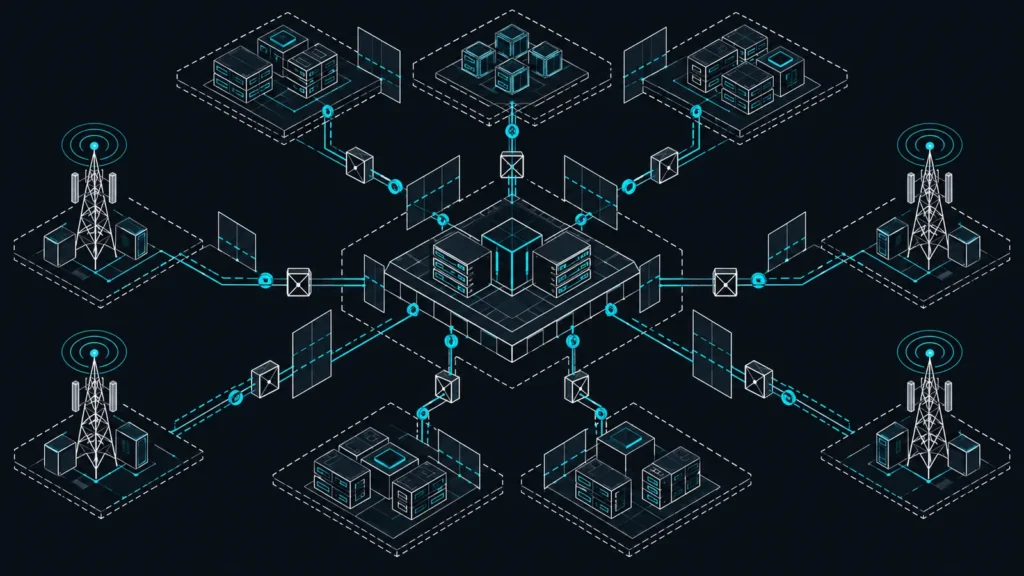

Network routing is rarely scrutinized from a security perspective until something goes wrong. BGP route hijacking incidents have affected major internet providers, cloud platforms, and financial institutions. OSPF without authentication allows rogue devices to inject false routing. In 2026, AI-assisted network reconnaissance makes routing security a priority for any organization with multi-site or internet-facing infrastructure.
BGP Security: Route Hijacking Prevention
RPKI: Resource Public Key Infrastructure
RPKI is the most significant BGP security advancement in decades. It provides cryptographic validation that a BGP announcement originated from an authorized Autonomous System. Deploy in two steps: (1) Create Route Origin Authorizations (ROAs) at your Regional Internet Registry. (2) Enable Route Origin Validation (ROV) on BGP routers to drop invalid announcements.
BGP Prefix Filtering
Never accept a default route from a peer unless explicitly required. Filter BGP prefixes aggressively: define maximum prefix limits per peer to prevent route table flooding, filter bogon ASNs (private ASNs 64512-65535 unless on internal eBGP), filter prefixes more specific than /24 for IPv4, use prefix lists or route-maps to reject invalid prefixes.
BGP Authentication
MD5 TCP authentication for BGP sessions prevents spoofed BGP OPEN messages. Configure on Cisco: neighbor x.x.x.x password STRONG_KEY. For modern deployments, TCP-AO (Authentication Option) provides stronger protection and is preferred where supported.
OSPF Security
OSPF Authentication
OSPF without authentication allows any device on the subnet to inject LSAs and manipulate routing. Enable MD5 or SHA-HMAC authentication. On Cisco IOS: ip ospf authentication message-digest and ip ospf message-digest-key 1 md5 STRONG_KEY. Configure all interfaces not running OSPF neighbors as passive: passive-interface default then explicitly activate required interfaces.
Control Plane Protection
Control plane traffic must be rate-limited and separated from data plane. Implement Control Plane Policing (CoPP) to rate-limit: OSPF, BGP, ICMP, SSH, SNMP packets destined for the router CPU. This prevents CPU exhaustion attacks that drop routing adjacencies.
🔗 Authoritative Sources
FAQs
What is BGP route hijacking?
BGP route hijacking occurs when a router incorrectly announces ownership of IP prefixes it does not control, misdirecting internet traffic. It can be accidental (misconfiguration) or malicious (interception). RPKI with ROV prevents hijacked routes from propagating.
What is RPKI?
RPKI (Resource Public Key Infrastructure) provides cryptographic proof that a BGP announcement comes from an authorized AS. Route Origin Authorizations (ROAs) specify which ASes can announce which prefixes. Route Origin Validation (ROV) on routers drops Invalid announcements. RPKI is the most effective tool against BGP hijacking.
Why does OSPF need authentication?
OSPF without authentication trusts all hello packets on connected subnets. A rogue device can inject false LSAs, redirecting traffic through attacker-controlled paths. MD5 or SHA-HMAC authentication prevents unauthorized participation in OSPF.
Key Takeaways
- Deploy RPKI ROAs for your IP prefixes and enable ROV on BGP routers
- Configure strict BGP prefix filtering with maximum prefix limits per peer
- Enable MD5 or TCP-AO authentication on all BGP sessions
- Configure OSPF SHA-HMAC authentication and passive-interface on end-user VLANs
- Implement Control Plane Policing to protect router CPUs from flood attacks
Conclusion
Routing security is infrastructure security. BGP without RPKI and OSPF without authentication leave critical routing infrastructure vulnerable. Deploy RPKI, filter prefixes aggressively, authenticate all routing protocols, protect control plane traffic. Related: Network Security Best Practices.
Sources
- RPKI Documentation – rpki.net
- BGP Security Best Practices – ripe.net, arin.net
- MANRS Routing Security – manrs.org
- Cisco IOS Security Configuration Guide – cisco.com
RPKI Deployment Steps
Create Route Origin Authorizations (ROAs) for all your IP prefixes in your RIR portal (RIPE, ARIN, APNIC). ROAs specify which AS numbers are authorized to originate each prefix. Enable Route Origin Validation on your border routers: set Invalid routes to reject, Unknown routes to accept, Valid routes to prefer. Use the RPKI dashboard at rpki-validator.ripe.net to monitor your coverage.
Key Takeaways
- RPKI with ROV prevents BGP route hijacking at the origin level
- Always authenticate OSPF with MD5 or SHA-HMAC to prevent rogue LSA injection
- Filter bogon prefixes on all border routers to block unroutable IP ranges
- Monitor BGP route changes with BGPmon or Cloudflare Radar for hijack detection