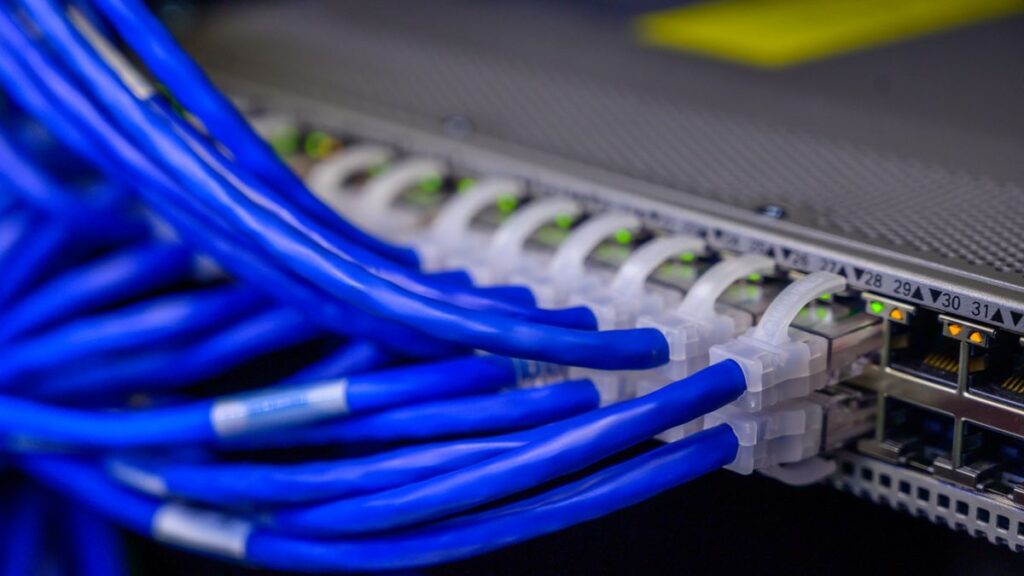

Network switching security 802.1X VLANs 2026 is one of the most critical topics in enterprise cybersecurity today. Network switches are often overlooked in security hardening programs. A misconfigured switch enables VLAN hopping, ARP poisoning, DHCP spoofing, and rogue device insertion. In 2026, with insider threats and lateral movement as primary post-breach techniques, switch hardening limits the blast radius of any single compromise.
VLAN Best Practices
Separate VLANs by Security Zone
Minimum recommended segmentation: Management VLAN (network devices only), Servers VLAN (production infrastructure), Users VLAN (workstations), IoT VLAN (printers, cameras, smart devices), Guest VLAN (visitor Wi-Fi, fully isolated), Voice VLAN (VoIP phones). Each VLAN is an isolated broadcast domain with inter-VLAN routing controlled exclusively by the firewall.
VLAN Hopping Prevention
Change the native VLAN on all trunk ports from VLAN 1 to an unused dedicated native VLAN. Explicitly tag the native VLAN on all trunks. Disable DTP on all non-trunk ports: switchport nonegotiate. Set all access ports explicitly: switchport mode access.
Spanning Tree Protocol Security
BPDUGuard
Enable on all access ports: spanning-tree bpduguard enable or globally: spanning-tree portfast bpduguard default. BPDUGuard error-disables any port that receives a BPDU, preventing rogue switches from becoming the STP Root Bridge.
RootGuard and PortFast
RootGuard prevents a port from becoming root bridge: spanning-tree guard root on uplink-facing ports. PortFast skips listening/learning states for fast host connectivity: spanning-tree portfast.
802.1X Port Authentication
802.1X requires every device to authenticate before the port grants network access. Deploy using: RADIUS server (Cisco ISE, Microsoft NPS, FreeRADIUS), authenticator (the switch), supplicant (device 802.1X client). Use EAP-TLS (certificate-based, strongest) or PEAP-MSCHAPv2 (username/password with server certificate). This is the most effective control against rogue device insertion.
DHCP Snooping and Dynamic ARP Inspection
DHCP Snooping prevents rogue DHCP servers: ip dhcp snooping on all VLANs, mark only uplink ports to legitimate DHCP servers as trusted. Dynamic ARP Inspection (DAI) validates ARP packets using the DHCP snooping binding table: ip arp inspection vlan 10,20,30. Combined, they prevent man-in-the-middle attacks at the switching layer.
Management Plane Hardening
- Disable Telnet completely:
transport input sshon all VTY lines - Enable SSH v2 only:
ip ssh version 2 - Restrict management access with ACLs on VTY lines
- Set exec timeout:
exec-timeout 5 0 - Disable CDP/LLDP on access ports facing end users
- Log all switch events to centralized syslog server
🔗 Authoritative Sources
FAQs
What is VLAN hopping?
VLAN hopping allows an attacker to send traffic to VLANs beyond their own by exploiting the native VLAN or DTP trunking protocol. Prevention: change native VLAN from VLAN 1, explicitly tag native VLANs on trunks, disable DTP on all access ports.
What does BPDUGuard protect against?
BPDUGuard protects against rogue switches on access ports. When a BPDU is received on a protected port, the port is error-disabled immediately, preventing an attacker from inserting a switch to become STP Root Bridge and intercept traffic.
What is 802.1X port authentication?
802.1X requires every device to authenticate to a RADIUS server before the switch port grants network access. It prevents rogue or unauthorized devices from connecting simply by plugging in. Certificate-based EAP-TLS provides the strongest authentication.
Key Takeaways
- VLAN segmentation limits lateral movement — minimum five VLANs for any enterprise
- BPDUGuard on all access ports prevents rogue switch and STP Root Bridge attacks
- 802.1X ensures every device authenticates before network access is granted
- DHCP Snooping plus Dynamic ARP Inspection prevent MITM at the switching layer
- Disable Telnet and DTP, enable SSH v2, restrict management access with ACLs
Conclusion
Network switch security is foundational to lateral movement prevention. VLAN segmentation, 802.1X, BPDUGuard, DHCP Snooping, and DAI together create a switching layer that limits attacker capability even after initial access. Related: Firewall Configuration Best Practices.
Sources
- Cisco Layer 2 Security Best Practices – cisco.com
- 802.1X Port Authentication Guide – rfc-editor.org
- CIS Controls v8 – cisecurity.org
VLAN Security Configuration
Change the native VLAN from default VLAN 1 on all trunk ports. Assign an unused VLAN as native and tag it explicitly. Set all access ports to a specific VLAN, never VLAN 1. Enable DHCP Snooping to prevent rogue DHCP servers. Enable Dynamic ARP Inspection on all user VLANs. Enable IP Source Guard to prevent IP spoofing on access ports.
Key Takeaways
- Never use VLAN 1 for production traffic – it is the default attack target
- BPDUGuard on all access ports prevents rogue switch STP takeover
- 802.1X port authentication is the only way to prevent unauthorized device access
- Disable DTP on all access ports to prevent VLAN hopping attacks
Training and Team Development
Security programs require sustained commitment from leadership and practitioners alike. The controls covered in this guide represent industry consensus on effective security practices, validated against real-world attack data and breach investigations. Implement them systematically, measure their effectiveness, and adapt as the threat landscape evolves. Organizations that treat security as a continuous program rather than a compliance checkbox consistently outperform their peers in both breach prevention and breach detection time, translating directly to reduced financial and reputational impact when incidents occur.